o:O:o
Distinction, Characterization
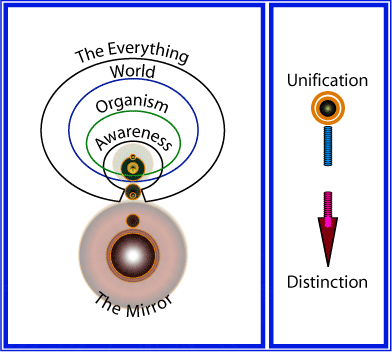
and Recognition are the trinity we might identify as the hallmarks
and goals of these processes. We vitalize these potentials by making
divisions in the mirror, characterizing the resulting figures, and
re-uniting them according to a logical scheme. An idealized model
of this process might look like this:
0. Distinguish self and externals
1. Distinguish subject of
attention (soa) from context(s)
2. Thingify - or - Verbify
the soa [it is an object, being, measure, quality or process]
3. Distinguish constituents
and relations of the soa, forming concentric ring-like patterns
around it.
4. Relink the constituents and relations
to their native soa parents and relations, revealing them as ‘filial’
symmetries. [add subordinal soa elements as predicates to the
primary]
5. Continue this process until
a ‘family’ of noded rings emerge in the mirror.
6. Link these rings to produce
a lexically viable symmetry. [protorecognition]
7. Render this process re-entrant
such that after the initial establishment it may be multiply re-established
within any aspect or element of itself and recursively
elaborated.
[1st-phase recognition]
8. Select the lexicon with
precedence for the tasks at hand, and adjunct lexicons for error-checks
and fallbacks.
9. Invoke the lexicons, and
comparatively verify the symmetries so far accrued. [2nd phase
recognition leads to verification or re-entrance]
Games akin to this model above form the foundations
of experience and memory, and allow us to parse, record, interpret
and report upon experience first to ourselves and then to others:
‘Yesterday I saw a 3-legged horse in the field near the big
dead tree, down at the creek.’
In general we are taught a single
mode of using the rod as a result of cultural and linguistic biases.
In fact, the rod has purposes and uses that would make Spock blush
with envy were they commonly accessible.
o:O:o